From CASS
Research
Research areas currently active in CASS include theoretical astrophysics; observational astronomy in the optical, UV, infrared, x-ray, and radio regimes; experimental and theoretical space plasma physics; planetary magnetospheres; solar physics; astrometry; studies of comets, asteroids, and meteorites; the origin and evolution of plentary systems; and galaxy evolution.
Optical observational facilites available to CASS scientists include the Lick Observatory on Mount Hamilton, California; the Keck Telescopes on Mauna Kea, Hawaii; and other national and international facilities. CASS scientists may also use a number of specialized research facilities including the San Diego Supercomputer Center (SDSC).
Observational Cosmology
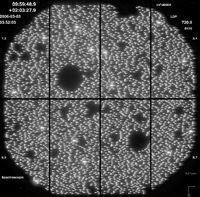
- Active Researchers: Alison Coil, David Tytler, and Kim Griest
- Active Galactic Nuclei (AGNs)
- Baryon number of universe
- Baryon Acoustic Oscillations (BAO)
- Changing fine structure constant
- Mass assembly history and chemical evolution of galaxies
- Damped Lyman alpha absorption systems
- Origin of Black Holes
- PRIMUS redshift survey
Gravitation Astrophysics
- Active Researchers: Tom Murphy and Eric Michelsen
- Lunar laser ranging: high precision measurements of earth-moon distance (to 1 mm !!)
- Mass-energy of space-time curvature
- Gravitomagnetism
CMB Polarization (Simons Array and Simons Observatory)
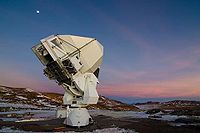
- Active Researchers: Brian Keating, Hans Paar, and Gabriel Rebeiz
- Observational Cosmology Group
- BICEP1
- BICEP2
- POLARBEAR Observatory
- Cosmic Infrared Background Experiment
- Probing absolute neutrino mass
- Gravitational radiation from inflation
- Simons Foundation
Origin of Structure
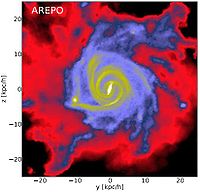
- Active Researchers: Michael Norman and Dusan Keres
- San Diego Supercomputer Center
- Computational AMR radiation hydro
- Galaxy formation simulation
- First stars
Dark Matter/Energy Theory
- Active Researchers: Kim Griest
- Gravitational microlensing
- Varying constants
- Surveys
Neutrino/Nuclear Astrophysics
- Active Researchers: George Fuller
- Collective neutrino oscillations in supernovae neutrinos in
cosmology/early universe
- Nucleosynthesis and nuclear/particle astro
- Collective neutrino oscillations in supernovae neutrinos in
Cosmic Rays, High Energy Astronomy
- Active Researchers: Steven Boggs, Richard Lingenfelter, Richard Rothschild, James Matteson, and Alex Markowitz.
- High Energy Astrophysics - HEAG
- High Energy Instrument Development and Science
- X-ray Detector development
- Gamma-ray astronomy
- Historical perspective on High Energy Astronomy paper by Dr. Laurence Peterson
Brown Dwarfs and Planets
- Active Researchers: Adam Burgasser and David Harker
- The Cool Star Lab
- Spectral and temporal characterization of ultracool dwarf atmospheres
- Cool star multiplicity and magnetic activity
- Planet formation and circumstellar disks
- Low-mass Galactic populations
- Infrared characterization of cometary dust
- Infrared Instrumentation (e.g., FIRE)
Plasma Astrophysics
- Active Researchers: Pat Diamond, Alexei Kritsuk, and Mikhail Malkov
- Gyrokinetic Particle Simulation of Turbulent Transport in Burning Plasmas (GPS-TTBP)
- Plasma Theory Group
Solar and Heliospheric Physics
- Active Researchers: Bernie Jackson and Andrew Buffington.