University of California, San Diego
Center for Astrophysics & Space Sciences

 |
Gene Smith's Astronomy Tutorial
Astronomical Telescopes |
|
This site has a good overview of
astronomical
telescopes. The principal function of an astronomical telescope is
light gathering, (magnification is largely incidental; while sometimes
useful, the huge magnification of the largest telescopes poses a difficult
challenge to astronomical instrument makers). There are two types of optical/infrared
telescopes:
focus light using lenses and the Principle of Refraction.
Look here to learn more than you ever wanted to know about refraction.
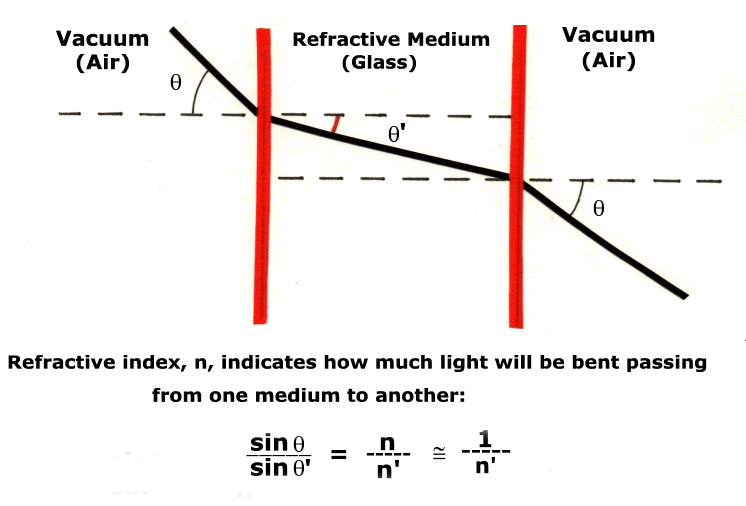
The Refractive Index of Air is very nearly 1 (nair = 1.0003, depending
on Temperature & Pressure, but astronomers need to take this into account
when calculating wavelengths in the earth's atmosphere). The refractive
index of water is nH2O = 1.33 and refractive indices for various kinds
of glass vary from about n = 1.5--1.8. A diamond's luster is partially
due to its high refractive index, n = 2.4.
Here's a Java Demonstration of the workings of a converging
lens.
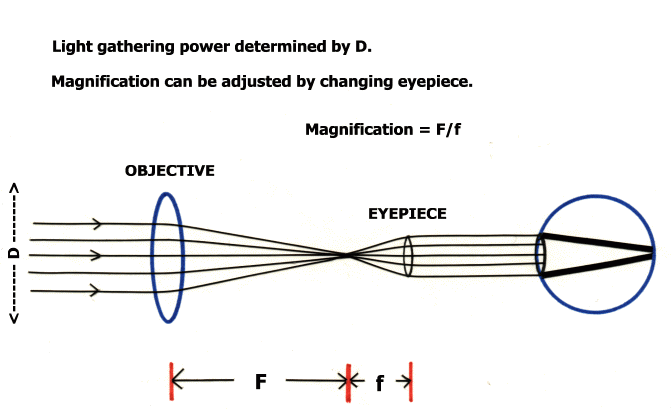
In order to look through a telescope you need two lenses, the objective
, which is the principal lens of the telescope, and an eyepiece. The image
scale in the focal plane is determined by F, the focal length of the
objective, the distance between the lens and the focused image. If you look
through the telescope, the magnification will be determined by the ratio of
the focal lengths of the objective and the eyepiece.
The sensitivity of the telescope is determined by the collecting
area of the objective lens (or primary mirror) which is proportional to
the square of its diameter.
|
The Great Refractor
of Lick Observatory in Northern
California
was completed in 1888. It was funded by a bequest from entrepreneur James
Lick, who is buried in the telescope mount. The objective lens (at the top of
the photograph) has a diameter of 36 inches; the lens has a focal length
of 57 feet, bringing light to a focus at the bottom of the telescope where
the observer is standing. The objective is actually composed of two lenses,
in order to correct partially for chromatic aberration. One is made of
Crown glass, the other Flint glass, which have different refracting
properties. For a brief period, the Great Refractor was the world's largest
optical research telescope. The telescope is no longer used for research, but
there is a Summer
Visitors' Program that allows visitors to observe through the
telescope and hear a popular lecture. Lick Observatory is operated by the
University of California for all Faculty, Research Staff and Students in
UC, including UCSD astronomers. |
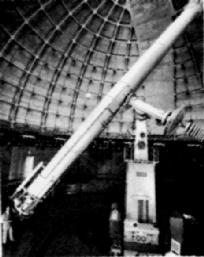
The Great Refractor of Lick Observatory |
Check this page if you are
farsighted
or this one if you are
nearsighted.
The tutorial continues with Reflecting Telescopes.
 Reflecting Telescopes
 Basic Forces & Light
 Education & Outreach
 CASS Home
Conducted by Gene Smith, CASS/UCSD.
Comments?
You may send email to hsmith@ucsd.edu
Prof. H. E. (Gene) Smith
CASS 0424 UCSD
9500 Gilman Drive
La Jolla, CA 92093-0424
Last
updated: 21 April 1999